

Future-Oriented & Integrative Devision
Advanced future-oriented sciences, technologies, infrastructures,
and integrative systems for human and planetary evolution.
Mission
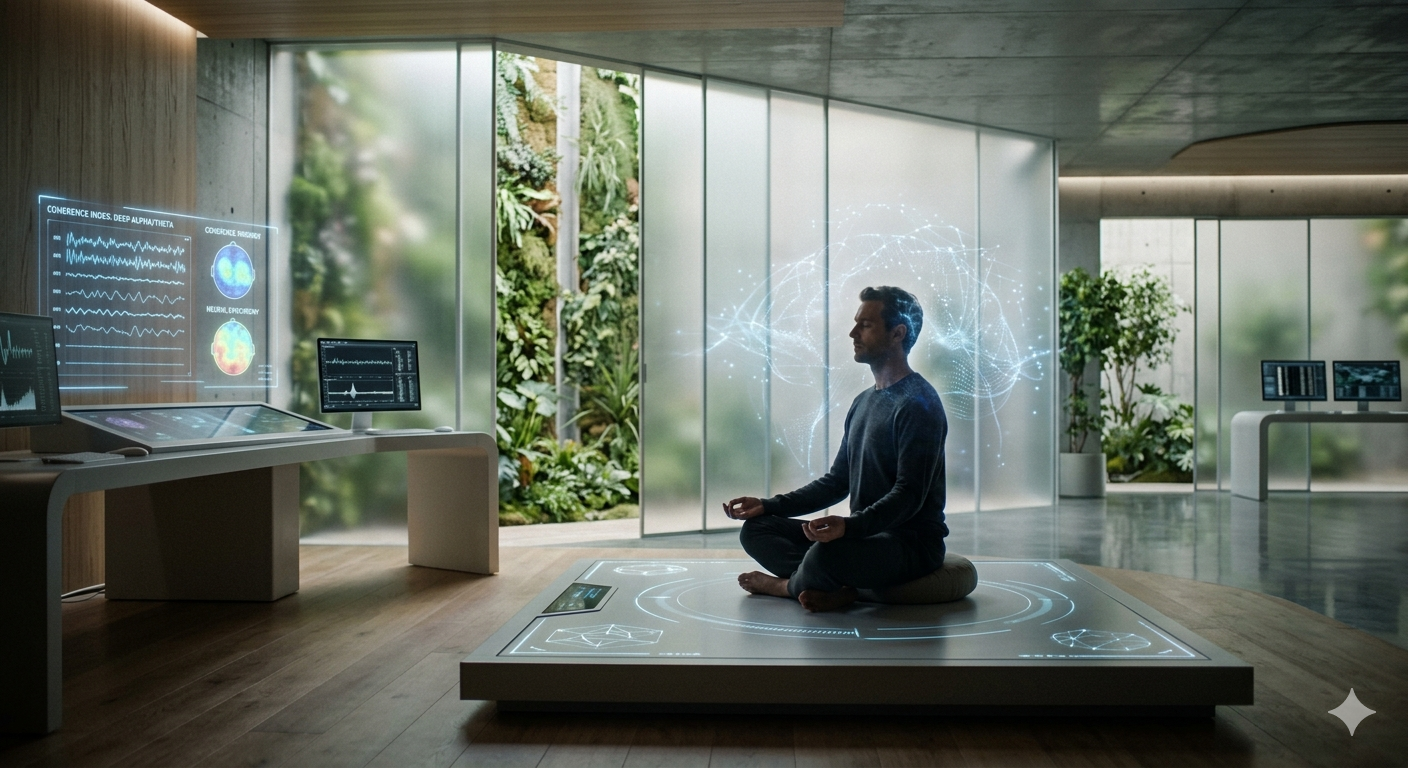
This division explores emerging scientific, technological, architectural, informational, and collective systems shaping the future of humanity, civilization, health, consciousness, and planetary wellbeing.
It investigates how advanced technologies, integrative sciences, human data systems, regenerative infrastructures, symbolic systems, collective intelligence, and future societal models can support a more coherent, conscious, resilient, and regenerative civilization.
The division integrates AI, bioinformatics, quantum biology, architecture, systems science, consciousness research, regenerative design, and future governance into an interdisciplinary framework for next-generation human development and planetary evolution.
-
Exploring the intersection of quantum phenomena, biological systems, coherence, and consciousness.
This chair investigates how living systems process information, self-organize, regulate coherence, and communicate through bioelectric, electromagnetic, photonic, and quantum-level interactions.
It explores emerging models of biology that move beyond purely mechanistic frameworks toward a deeper understanding of life, intelligence, and consciousness.
Research Areas:
Quantum biology
Cellular communication
Bioelectric systems
Electromagnetic coherence
Consciousness and matter interaction
Light-based biological communication
Water and biological organization
Coherence and resonance systems
Information fields in living systems
Human energetic organization
Regenerative biological systems
Future models of biology and consciousness
-
Building the next generation of human-centered health intelligence systems.
This chair focuses on the integration, interpretation, protection, and meaningful application of biological, behavioral, environmental, and longitudinal health data.
It investigates how data systems, biometrics, predictive analytics, and AI-driven models can support preventive health, personalized medicine, human optimization, and long-term wellbeing while preserving data sovereignty and ethical governance.
Research Areas:
Bioinformatics
Biometric analytics
Longitudinal health systems
Predictive health modeling
Human data infrastructure
Health data sovereignty
AI-driven pattern recognition
Digital biomarkers
Secure health ecosystems
Data ethics and governance
Personalized health intelligence
Human-centered data systems
-
Researching the future relationship between artificial intelligence, human consciousness, ethics, and civilization.
This chair explores how technology can support human flourishing, cognitive augmentation, wellbeing, autonomy, collective intelligence, and conscious societal development.
It investigates ethical frameworks and human-centered approaches for designing technologies aligned with human values, resilience, and long-term planetary wellbeing.
Research Areas:
Ethical AI systems
Human-centered technologies
Conscious technology design
AI and society
Digital sovereignty
Human-machine interaction
Collective intelligence systems
AI governance and ethics
Future civilization technologies
Cognitive augmentation systems
Technology and human evolution
Responsible innovation frameworks
-
Investigating sound, vibration, resonance, and frequency as foundational dimensions of biological regulation and consciousness.
This chair explores how frequencies influence physiology, emotions, cognition, nervous system regulation, environmental perception, and states of awareness.
It investigates acoustic, vibrational, and resonance-based systems as emerging tools for health, regulation, learning, and human optimization.
Research Areas:
Sound therapy
Resonance and coherence
Vibrational medicine
Frequency-based regulation
Psychoacoustics
Music and neurobiology
Acoustic environments
Brainwave synchronization
Voice and human expression
Nervous system regulation through sound
Cymatics and pattern formation
Healing through sound
-
Studying human connection, communication, relational systems, and collective human dynamics.
This chair investigates how relationships, trust, communication, social structures, and group coherence influence wellbeing, decision-making, collaboration, resilience, and societal evolution.
It explores collective intelligence as an emergent property of healthy relational systems and conscious human interaction.
Research Areas:
Relational intelligence
Group coherence
Communication systems
Collective behavior
Community resilience
Social neurobiology
Trust and collaboration
Human networks
Conflict transformation
Emotional intelligence systems
Collective decision-making
Emergent collective systems
-
Researching geometry, universal patterns, symbolic structures, and mathematical organization within nature, consciousness, architecture, and human cognition.
This chair investigates how symbolic and geometric systems influence perception, spatial awareness, biological organization, architecture, culture, and human meaning-making.
It explores geometry and symbolism as foundational informational structures across civilizations and living systems.
Research Areas:
Sacred geometry
Symbolic cognition
Universal patterns in nature
Archetypal systems
Geometry and consciousness
Spatial intelligence
Mathematical harmony systems
Pattern recognition
Geometry in biology and architecture
Symbolic communication systems
Structural organization in living systems
Informational design principles
-
Designing environments that support human vitality, coherence, regeneration, longevity, and collective wellbeing.
This chair investigates how architecture, urban systems, natural environments, spatial design, climate, and community structures influence physical, emotional, cognitive, and social health.
It explores regenerative habitat models integrating nature, health systems, human behavior, and future-oriented living environments.
Research Areas:
Longevity-oriented architecture
Regenerative habitats
Biophilic design
Healthy building systems
Environmental psychology
Human-centered urbanism
Climate-adaptive living systems
Healing environments
Nature-integrated communities
Spatial wellbeing systems
Future habitat ecosystems
Regenerative architectural design
-
Studying humanity through biological, cultural, symbolic, spiritual, and consciousness-based dimensions.
This chair investigates the evolution of human identity, meaning systems, rituals, developmental pathways, spiritual traditions, and civilizational transformation across cultures and historical periods.
It explores the relationship between consciousness evolution, collective development, and future models of human civilization.
Research Areas:
Spiritual anthropology
Comparative civilizations
Human evolution
Ritual and initiation systems
Mythology and symbolic structures
Consciousness across cultures
Identity and transformation
Ancient wisdom traditions
Evolution of values and societies
Human developmental pathways
Collective consciousness evolution
Civilizational transformation
-
Researching leadership, organizational systems, governance models, and economic frameworks that support human wellbeing, regeneration, and collective flourishing.
This chair investigates how purpose-driven leadership and conscious economic systems can shape healthier societies, resilient organizations, regenerative communities, and future civilization models.
It explores new forms of governance, decentralized systems, vitality-centered economics, and human-centered organizational development.
Research Areas:
Conscious leadership
Purpose-driven organizations
Human-centered economics
Regenerative economic systems
DAO and decentralized governance
Organizational psychology
Ethics and value creation
Future governance systems
Leadership psychology
Vitality-centered economies
Collective coordination systems
Societal transformation models